"Inspirational"
The Game Changing Story of a Deaf Composer and the Profound Lessons About Music He Has For Us All

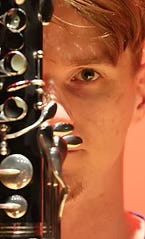
Tyler Mazone has something to teach us - certainly something to teach me.
Achieving success in his chosen field has given him special skills. And In many ways, his life’s path defies logic.
Mazone is a musician. An accomplished musician.
He plays clarinet, bass clarinet and is a respected composer, who has written for bands, orchestras, chamber music and even video games. The slightly built redhead with sparkly eyes is currently a PhD candidate on full scholarship in music composition at Michigan State University.
Also, Mazone is deaf.
I first met him when he conducted the Lansing Concert Band (of which I am a member) in the Holst Suite #1, a classic band work. At the time, I knew he was a composer and was impressed by his enthusiasm, positive personality and high energy. His speaking voice was a bit distinctive, but nothing very unusual.
I was surprised to learn later that he is almost totally deaf. How can a deaf person perform and compose music?
Meeting over coffee, Mazone told me, “I listen to music with all my senses. I feel the vibrations, see how people play and react to music, and I do hear some of it through my ears. When I play with the concert band, I’m watching everyone else around me move to the music and I am also feeling the music, like, it’s a feeling you can’t get from listening through headphones. I can feel the tuba and the percussion and lower instruments that resonate.
“When I’m composing, I’m not just thinking about what sound the instruments are going to make, I’m also thinking about what the audience members or even what the performers are going to experience with all their senses.”
When he is conducting, Mazone says, “I have to hear it in my head first, before I pull the sound from the band. That takes years of training to realize a score in your head.”
Mazone is a superb lip reader, although he has two ASL (American Sign Language) interpreters who accompany him to all his classes at MSU, except for the one-on-one meetings with his professors.
Julianne Kirk Doyle, his clarinet professor at the SUNY Crane School of Music in Potsdam, NY where he received his undergrad, said, “Tyler is inspirational.”
As a high school senior Mazone traveled from his home in Albany, NY, to audition for admittance to Crane, and asked Doyle for a private clarinet lesson the day before the audition.
Doyle remembers the lesson vividly, “Before we began the lesson, he said to me, You know, I read lips and I need to see your face so I can understand what you’re saying, because I can’t hear very well.
“When Tyler came back the next day for the audition he had changed so much – he made huge improvements based on his lesson with me. Most students his age would have taken a few weeks to make his level of improvement. For him, it was overnight.
“I told him, Wow, you listen more than some of my students who can hear. You listen in a different way. You’re more attentive to the detail. I remember being gobsmacked. He was so open to change.”
The clarinet professor was fascinated by the way Mazone processed music. “It’s a different experience for him. In terms of musicality, we talked about the shape and direction of the music. He was a very intuitive musician. He was refreshing to have as a student.”
By the time he entered Crane, he had already written about five compositions in high school.
Doyle commissioned Mazone to write a piece for her. “I commissioned him to write a piece that I premiered last summer at a conference in Ireland – and it’s stunning. We both lost pets around the same time so I commissioned him to write a piece to commemorate the feelings of loss and he really put his heart into it. It’s just beautiful.”
Video games opened Mazone to the wonders of music. “I played the Nintendo DS, so I was holding it in my hands and my hands were very close to the speakers so I could feel and hear the music through my hands. I began my art of composing by arranging music for video games.”
Because of the game music influence, Mazone wanted melody to play a key part of his music, but he also thought about the listeners. “For me, it is important to have something for the audience and players to latch on to, you know, something that they can sing when leaving the hall.”
In addition to gaming, Mazone also was very involved with martial arts growing up. He said that the discipline of martial arts was very similar to learning music. He began by playing clarinet because in the cartoon SpongeBob SquarePants, the main character played clarinet.
Earlier this year, the MSU orchestra featured a new work by Mazone called “Korat”, a celebration of his pet cat.
He said a few words to the audience before the performance, which charmed everyone: “It’s perfect that my new piece is being premiered tonight. The other two works on the program are by Shostakovich and Beethoven. Shostakovich was Russian and I was born in Russia and adopted at 13 months old. And Beethoven was deaf, and so am I.”
In reality, Beethoven became deaf as he grew older. Mazone was born deaf. He says, “Beethoven had time to internalize music, I did not.”
His adopted mother is a sales consultant, and his father is a plumber and they always supported Mazone in his musical endeavors.
When he graduated from Crane, he was offered scholarships for graduate school from the New England Conservatory inBoston and MSU.
He came to MSU to work with the nationally known music composition faculty; Ricardo Lorenz, David Biedenbender and Zhou Tian. They did not make any changes in their teaching methods to accommodate Mazone.
Tian said, “Tyler is the most devoted and hardest working student I have ever had.”
Lorenz looked at Mazone’s disabilities in a different way. He said, “I have other students who have superpowers. We all have issues.”
But in the next sentence Lorenz said, “Tyler is a joy to have in the program and to work with. He’s a very special student, colleague and peer.”
Lorenz mentioned that there is nothing in Mazone’s music that suggests that he is deaf.
Mazone first met Biedenbender at a conference where the professor encouraged the young composer to continue his studies at MSU. He said, “Tyler is an extraordinarily creative composer. He is also a great teacher. He is now teaching music theory for us and just won an award.”
When asked how he is able to study, perform and compose music without normal hearing, Biedenbender said, “For Tyler, it’s a full body experience. He uses sight, body language and vibration. It’s amazing. People who don’t pay close attention have no idea that he is deaf.”
Tian mentioned how productive Mazone is, quickly composing many works for a variety of instruments. “His music speaks so brilliantly. It’s very moving to work with him. He has this desire to tell the world that someone like him has music to share.”
Doyle from Crane said, “He’s so positive. I would tell colleagues; I would take a whole studio full of students like Tyler over the kids with egos who could play circles around him.”
Those of us who have played music for many years, know that the real power of music is the emotional impact it has on listeners and performers. The fact that Mazone hears music differently than most has not hindered his emotional connection to music.
In high school, his band played a piece of music that the musician became attached to (“Chorale and Shaker Dance” by John Zdechlik). He told me, “I really loved that piece in high school. In my senior year I went through a difficult time, and the music really helped me. It was because of that piece that I decided to become a composer.”
I don’t truly understand how Tyler Mazone experiences music.
But, learning more about him has given me more insight into music itself.
Mazone has taught me that that profound impact music has on us is the same, even for those who hear it in totally different ways. Through Mazone, I now understand that the intense power of music transcends the conventional ways most of us experience It. Somehow it finds a way to enter our brain and helps us how to evaluate the world around us.
Mazone has a lot to teach us all.